Sara Wasserbauer MD

Medical Hair Restoration

To schedule your consultation call 925-939-4763

Articles

Wound Healing for the Hair Transplant Surgeon

Click on the image above to download a PDF version of Dr. Wasserbauer's entire article on wound healing.

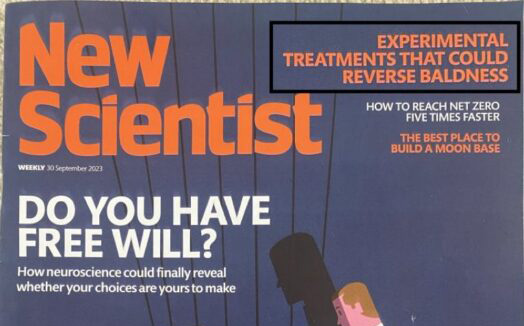
Dr. Wasserbauer is a regular contributor to the Hair Transplant Forum International, a publication distributed by the International Society of Hair Restoration Surgeons (ISHRS.org). In the March/April 2012 Issue she was asked to compile and comment on the evolution and physiology of wound healing in the hair transplant procedure. Her paper was the featured cover story.

In the article overview Dr. Wasserbauer states:

“Wounds created with a scalpel heal faster than those created by destructive means (laser or chemical cautery among them) so avoiding excessive tissue damage (such as with the use of tissue spreading) results in faster healing.

Any foreign debris will slow wound healing by making the body do more work and possibly causing infection, so removing all spicules of hair and having high levels of vigilance with suture removal will improve outcomes.

Keeping tension from the wound during healing is key to speedy recovery. There are several means that can be employed to minimize tension, chief among them being sub-cuticular sutures, avoiding lifting, and avoiding wide strip excisions where elasticity is low”

And concludes:

“In the final analysis, it is the experience and judgment of the surgeon that will result in a good outcome or avoid a poor one. Like it or not, the wound healing experiences of every hair transplant procedure a surgeon performs will reflect on his or her practice and on our medical specialty as a whole. Thus, we all owe it to each other and our patients to do everything in our power to produce optimal healing.”

Posted in Articles, News | Tagged , , , , | Leave a comment

Trying To Understand The Benefits of an FUE Hair Transplant

I really would like to have a hair transplant, but I’d prefer not to have long scar on the back of my head. My concern is if the back of my hair thins over time that the scar will become visible.

Does it make more sense to have FUE as opposed to a strip hair transplant, just in case I do thin out more in the back and the sides? I figure that if this does happen, I can always just shave my head to a #2 and go on with my life without the fear of having a visible scar. Is this a logical approach, or have I misunderstood the benefits of FUE?
– - – - – - – - – - – -

Thank you for taking the time to write. You question is astute in that you are trying to take into account future hair loss – something not every patient thinks about. Let me try to answer you as best I can without examining you.

If you have thin hair at the back of your head, FUE may be your best option. You definitely need to check with a hair surgeon though to make sure you don’t have a diffuse unpatterned alopecia (in which case surgery would be ill-advised). FUE is a viable option for you providing you have been tested and found to be a good candidate. The testing consists of actually trying to extract a few grafts and making sure they can be removed intact. In my experience, about half of the patients who are interested in this technique are candidates for it. Recall that the actual scarred AREA (cm2) in FUE is likely greater than in the traditional strip method – it is just in little dots all over the back of your head instead of a line!

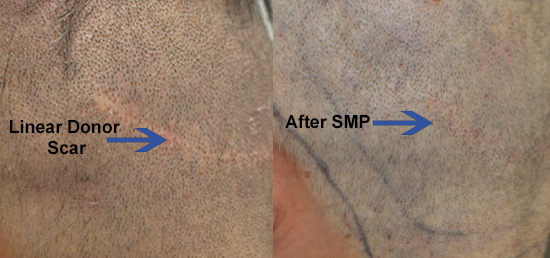
That being said, it is unlikely with EITHER method that the hair in your donor area will thin visibly OR that you would have to worry about the scar being visible if you shave your head down to a #2. The average donor area does not thin that much over time which is what makes hair restoration possible in the first place. Also, most scars performed by careful surgeons using trichophytic and a double closure (sutures both above and below the skin to reduce tension) will become visible between #2 and #3 on the average barbershop clippers. FUE is more expensive (due to the time and effort involved) and yields fewer grafts than the strip method, but since it is not as commonly performed, we have less data on its benefits than we do for the more traditional methods.

In the final analysis, the decision is up to you. You present a logical approach to try to head off potential problems, but the problems you are trying to avoid are less likely than you think. My suggestion would be to consult an experienced surgeon to make certain you do not have abnormal donor area thinning, that you are a candidate for FUE, and to make your decision from there once you have all the data! Viewing the scars of some live patients can also help.

I hope that helps!

Warm Regards,
Dr. Sara Wasserbauer

Posted in Articles | Tagged , , , , , | Leave a comment

What Are The Best FUE Techniques Currently Being Used?

Question: I’m very interested in having an FUE hair transplant but I’m starting to get confused with all of the different FUE techniques being offered. Do I have a Neograft FUE  (which is extremely expensive), CIT or SAFE?  I also read something about FUE2 . Your website seems to be more straight forward then others and it seems that most FUE is very similar from what I am reading from your organization. I’d like to feel comfortable with my decision to move forward, but this is a big step for me and I keep reading conflicting information on other websites. Can you tell me the best FUE techniques and do you recommend FUE over FUT? Thank you for your time and I look forward to any answer that you can provide. ~Ross
- – - – - – -

Answer: There are no comprehensive studies yet on any of the technologies that you mentioned, the NeoGraft, FUE2, and the SAFE Scribe System. All of these different technologies have their advantages and disadvantages. For instance, the Neograft uses suction to help the doctor get the graft out of the head. The SAFE Scribe has a dull tip instead of a sharp tip, and really no one really knows what the best way is to help a doctor take those individual follicular units out of your donor area out of the back of your head.

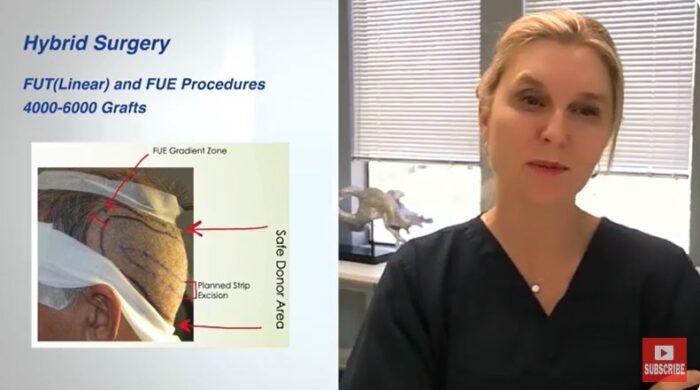
There are a couple things about FUE in general that you should know. View Dr. Wasserbauer’s Full Video Response below:

Posted in Articles | Tagged , , , , , | 1 Comment

Is It Acceptable To Transplant Hair Into Areas of The Scalp That Are Only Thinning?

Do the majority of hair transplant doctors consider it appropriate to transplant hair into thinning areas, e.g., front, mid-section, and/or crown, as opposed to transplanting hair only into bald areas? What are the risks and considerations (e.g., shock loss)? – Robert
– - – - – - – -

Robert,

Thank you for taking the time to write! I am not sure I can speak for the majority of hair transplant surgeons, but through my training and experience with many of the top surgeons out there, the short answer to your question is; it is a judgement call.

The chief concern, as you identified, is whether you will do more harm to the existing hair, than good! If the existing hair is close to complete loss, I believe many surgeons would choose to help that patient by restoring a conservative area of hair/hairline.

If the hair in the area seems to be salvageable, some surgeons would feel more comfortable trying medical therapy alone for 6-12 months, while others would simply exercise caution during the transplant. Too many grafts at once with the latter approach can exacerbate shock loss, especially if the patient has fine or miniaturized hair to begin with.

If you believe you are in this latter category, it is always best to go with the hair surgeon who levels with you about the risk of shock loss; you will be replacing the hair with permanent hair, so you will have a net benefit, but the risk of significant shedding with more limited re-growth does exist.

All of the above refers to hair on the top of the scalp no matter where it is thinning. I’d like to mention, however, that the crown is a unique area with its own set of problems. If the only thinning area you want to fill in is the crown, a patient should seriously consider going on Propecia or deferring surgery entirely until it is clear that the frontal area will not need the grafts more than the back!

The reason is that the grafts are in limited supply, and you want to be able to place them in the most cosmetically beneficial area possible – get the most bang for your grafts! – so to speak. The most cosmetically beneficial area is almost always the front, since it is a natural balding pattern to have some crown loss but still have your face framed conservatively. So, whether there is some hair remaining in the crown area or not, many hair physicians would think twice about treating this area aggressively.

I hope that answers your question! Remember that the best surgeons will not treat any area that still has hair in it without having a long discussion with the patient about expectations and alternative medical treatments first. Good luck and I wish you good hair!

Warm Regards,
Dr. Sara Wasserbauer

Posted in Articles | Tagged , , , , | Leave a comment