Sara Wasserbauer MD

Medical Hair Restoration

To schedule your consultation call 925-939-4763

Posts tagged: fue

Dr. Wasserbauer Leads Robotic Hair Restoration FDA Trial
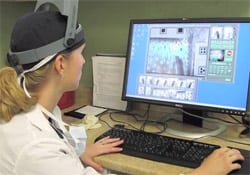
Sara Wasserbauer, M.D., is leading a research study involving robotic hair transplant technology. One of only two sites, Dr. Wasserbauer is conducting the final phase for FDA approval of this new technology that uses an interactive image-guided robotic system to remove and implant hair grafts on a scalp.

The Restoration Robotics™ ARTAS System is an interactive, computer assisted technique utilizing image-guided robotics to enhance the quality of hair follicle harvesting. Operated under the direction of a physician, ARTAS has the potential to solve most of the technical challenges inherent in the manual follicular unit extraction (FUE) techniques.

During the two-year study, Dr. Wasserbauer has been collecting data on the effectiveness of the ARTAS technology by itself and compared to manual hair transplantation techniques. Entering the final stage of the research, Dr. Wasserbauer will be examining the rate of hair growth in patients nine months after having their ARTAS System hair transplant.

“It’s quite amazing to think how far technology has come,” said Dr. Wasserbauer. “The use of robotics is already used in many fields of medicine – especially in surgical procedures. I’ve been very excited about this particular study and am enjoying being part of the research team to determine the pros and cons of using robotics in hair restoration.”

So far, Wasserbauer has found several benefits of using the robotics technology for follicular unit extraction, including:
• Shorter healing times due to minimal wound size with each graft
• Less invasive surgery
• Hair transplant completed in five hours, compared to eight to ten manual hours
• Less labor intensive for the surgeon

The ARTAS System combines several features including an interactive, image-guided robotic arm, special imaging technologies, small dermal punches and a computer interface. After the System is positioned over the patient’s donor area of the scalp, ARTAS is capable of identifying and harvesting individual follicular units. The follicular units are stored until they are implanted into the patient’s recipient area using the latest manual techniques.

The Restoration Robotics study will end this year in August, when Dr. Wasserbauer will report her findings and plans to present the study results at the annual meeting of the International Society of Hair Restoration Surgery.

Posted in News | Tagged , , , , , , , | 4 Comments

Trying To Understand The Benefits of an FUE Hair Transplant

I really would like to have a hair transplant, but I’d prefer not to have long scar on the back of my head. My concern is if the back of my hair thins over time that the scar will become visible.

Does it make more sense to have FUE as opposed to a strip hair transplant, just in case I do thin out more in the back and the sides? I figure that if this does happen, I can always just shave my head to a #2 and go on with my life without the fear of having a visible scar. Is this a logical approach, or have I misunderstood the benefits of FUE?
– - – - – - – - – - – -

Thank you for taking the time to write. You question is astute in that you are trying to take into account future hair loss – something not every patient thinks about. Let me try to answer you as best I can without examining you.

If you have thin hair at the back of your head, FUE may be your best option. You definitely need to check with a hair surgeon though to make sure you don’t have a diffuse unpatterned alopecia (in which case surgery would be ill-advised). FUE is a viable option for you providing you have been tested and found to be a good candidate. The testing consists of actually trying to extract a few grafts and making sure they can be removed intact. In my experience, about half of the patients who are interested in this technique are candidates for it. Recall that the actual scarred AREA (cm2) in FUE is likely greater than in the traditional strip method – it is just in little dots all over the back of your head instead of a line!

That being said, it is unlikely with EITHER method that the hair in your donor area will thin visibly OR that you would have to worry about the scar being visible if you shave your head down to a #2. The average donor area does not thin that much over time which is what makes hair restoration possible in the first place. Also, most scars performed by careful surgeons using trichophytic and a double closure (sutures both above and below the skin to reduce tension) will become visible between #2 and #3 on the average barbershop clippers. FUE is more expensive (due to the time and effort involved) and yields fewer grafts than the strip method, but since it is not as commonly performed, we have less data on its benefits than we do for the more traditional methods.

In the final analysis, the decision is up to you. You present a logical approach to try to head off potential problems, but the problems you are trying to avoid are less likely than you think. My suggestion would be to consult an experienced surgeon to make certain you do not have abnormal donor area thinning, that you are a candidate for FUE, and to make your decision from there once you have all the data! Viewing the scars of some live patients can also help.

I hope that helps!

Warm Regards,
Dr. Sara Wasserbauer

Posted in Articles | Tagged , , , , , | Leave a comment

What Are The Best FUE Techniques Currently Being Used?

Question: I’m very interested in having an FUE hair transplant but I’m starting to get confused with all of the different FUE techniques being offered. Do I have a Neograft FUE  (which is extremely expensive), CIT or SAFE?  I also read something about FUE2 . Your website seems to be more straight forward then others and it seems that most FUE is very similar from what I am reading from your organization. I’d like to feel comfortable with my decision to move forward, but this is a big step for me and I keep reading conflicting information on other websites. Can you tell me the best FUE techniques and do you recommend FUE over FUT? Thank you for your time and I look forward to any answer that you can provide. ~Ross
- – - – - – -

Answer: There are no comprehensive studies yet on any of the technologies that you mentioned, the NeoGraft, FUE2, and the SAFE Scribe System. All of these different technologies have their advantages and disadvantages. For instance, the Neograft uses suction to help the doctor get the graft out of the head. The SAFE Scribe has a dull tip instead of a sharp tip, and really no one really knows what the best way is to help a doctor take those individual follicular units out of your donor area out of the back of your head.

There are a couple things about FUE in general that you should know. View Dr. Wasserbauer’s Full Video Response below:

Posted in Articles | Tagged , , , , , | 1 Comment

FUE Hair Transplant Primer

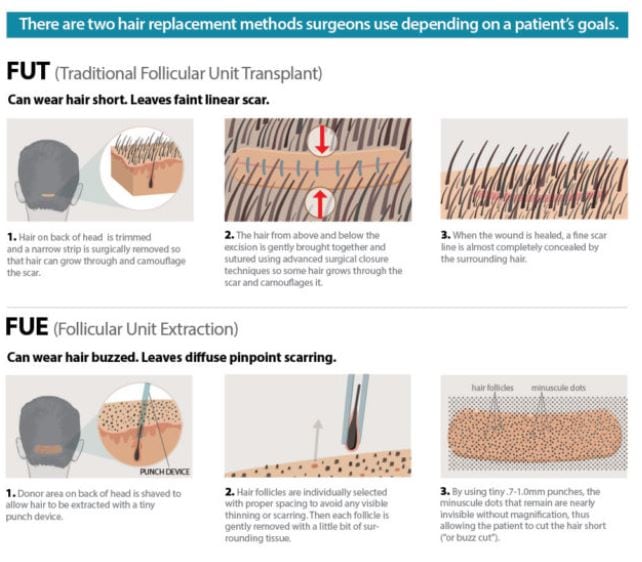
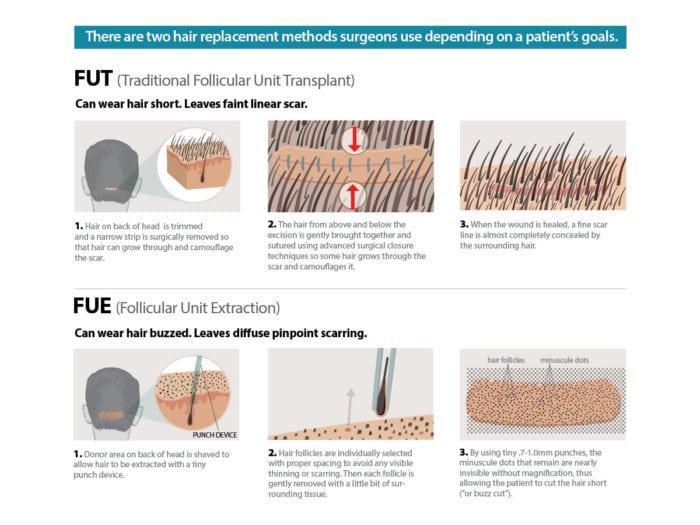
As one of the few docs who does FUE routinely in my practice, I think it is interesting that all sorts of new methods for automating the process are being introduced. There have been many iterations of these machines and while none has yet panned out perfectly, I do see some hope on the horizon! For those of you who are novices to the idea here is a comparison of the two techniques;

TRADITION! The traditional FUT (Follicular Unit Transplantation) or “Strip” technique takes a thin strip of hair from the back and sides of your head. The two sides are brought back together leaving a thin line typically 1-2mm wide as the scar. Often, a “trichophytic closure” is used which allows the hair to grow through the scar, rendering the scar all but invisible. This scar is typically visible only if you buzz your hair shorter than a #2 on a pair of standard clippers (or if you shave your head with a razor.) It is typically NOT visible if you cut the hair at a #3 on clippers (or if you leave it even longer). This goes for wet and dry hair I find.

Traditional hair transplant methods result in stitches for about 7-10 days and obtain up to several thousand grafts per session. The surgery usually takes 8-10 hours (plan on being there the whole day although smaller sessions can end earlier). There is typically nothing visible in the donor areas (back and sides of the head), even immediately after the the procedure! Good surgeons typically charge $4-5 per graft giving it a variable price tag but usually in the $5-$13K range. (Cut-rate grafts are no bargain!) Most hair surgeons agree that this method is generally best for those looking for a single large session and as close to a full correction as possible in a single surgery.

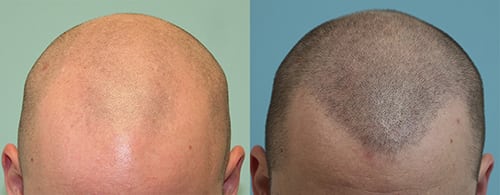
FUE! Follicular Unit Extraction (FUE) also takes grafts from the back and sides of the patient’s head individually. Depending on how the patient prefers it, you can either shave the whole head or small “micro-strips” can be shaved for optimal camouflage – but some level of shaving has to be done because the hair has to be short for effective removal. The scars are small – about 1mm in diameter, and if you shaved the head they would look like little dots scattered all over the head. You actually have more scar area with this method, but since it is not in a LINE it is much harder to see!

FUE transplants take a full day as well (8-10 hours) and requires that the patient lies face down and on their side for long periods while the grafts are being removed. Recovery takes about 3-5 days and while there are no stitches, you do have a number of little tiny scabs all over your head which can be covered with hair (or just open if the patient can shave their whole head to start with.) If you shave your whole head, I like to compare the look to being hit with a shot gun, but it heals to a bunch of tiny little pink spots very quickly so amazingly, the patients who choose this option do not seem to mind! Surgeons who practice this technique typically can obtain 500-1000 grafts in a single session and charge $20 or more per graft. The range is large since the success of the procedure depends largely on patient variables that cannot be fully determined until the surgery starts. Most hair surgeons agree that this method is generally best for those looking for a single small session or several smaller sessions to achieve a full correction.

Hope that helps everyone!

Cheers!

Dr. Sara

Posted in Articles | Tagged , , , , , , | Leave a comment